
Biotechnology
Advancing Biotechnology Capabilities that strengthen National Security
National security is increasingly dependent on biotechnology as it has the potential to advance as well as threaten every strategic sector including defense, healthcare, agriculture, energy and manufacturing. From food safety, health & medicine, supply chain issues, production of critical chemicals and renewable energies, advances in biotechnology create unprecedented opportunities as well as complex challenges in the national security space.
The National Security Institute’s Biotechnology pillar brings together internationally recognized researchers from across Penn State with expertise in such diverse areas as computational biodesign, synthetic biology, biorenewables & biofuels, biosensors, nanomaterials and biomaterial engineering to create transformational technologies that will directly impact national security demands.
Researchers across Penn State are advancing the science of biotechnology that will address technology gaps in biosensors, biomaterials, AI-enabled biodesign, supply chain insecurities, and energy that will transform the national security landscape.

Why It Matters
The dual-use nature of biotechnology creates considerable implications for deterrence, force protection, logistics & supply chains, and direct operational capability.
Penn State researchers are advancing technologies that:
- Develop bio-inspired materials and protective systems
- Create autonomous microbial sensing and CBRN detection systems
- Establish AI-driven biodesign and digital twins to enhance biomanufacturing
- Enable field-deployable biomanufacturing for critical parts, materials, and chemicals
Areas of Excellence
Biomaterials
Faculty are developing novel hybrid materials and bio-based materials that are more capable and resilient than purely synthetic products, have characteristics that can be specifically tailored to unique operating environments and can be produced domestically reducing supply chain and logistics stressors.
Biosensors
Penn State researchers are designing and building biosensors that provide real-time physiological, environmental and biochemical data to assess readiness under extreme conditions and enhance the human-machine interface making human-machine collaboration more intuitive, adaptive, and efficient.
Synthetic Biology
Penn State researchers are working at the interface of genetics, chemical biology, computational biology and engineering to understand the design principles that allow for the directed evolution of biologics to combat the most difficult technology gaps.
Featured Facilities and Centers
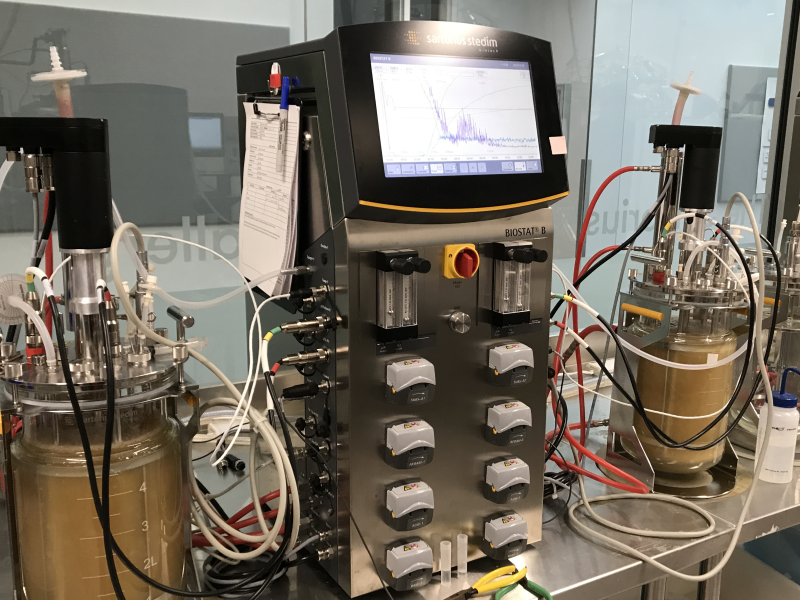
CSL Behring Fermentation Facility
The Biomolecular Interactions Core Facility provides state-of-the-art instrumentation, software and expertise to support investigators to study macromolecular binding and folding, as well as protein and lipid quantification.

Biomolecular Interactions Facility
The Biomolecular Interactions Core Facility provides state-of-the-art instrumentation, software and expertise to support investigators to study macromolecular binding and folding, as well as protein and lipid quantification.
Faculty Leadership Spotlight

Dr. Amanda Clase
Associate Research Professor
Amanda Clase serves as the lead for the Biodefense Initiative at the Applied Research Laboratory and is an Associate Research Professor of Global Health at the Huck Institutes of the Life Sciences. She is a nationally recognized leader for National Security in Biodefense having served the Department of Defense and the Intelligence Community for over twenty years.
Prior to her time at Penn State Applied Research Lab, she served as the senior scientist and program manager for the Defense Intelligence Agency (DIA), Directorate for Science and Technology (DS&T), Advanced Technology Intelligence for Life Sciences (ATI). She is also serving a three-year appointment (2024-2027) to the Defense Advanced Research Projects Agency – Information Science and Technology study group (DARPA-ISAT) which provides DARPA with a continuing and independent assessment of the state of advanced information science and technology as it relates to DARPA’s current programs and possible future directions that are important to national security.
Her work has spanned the entire operational life cycle from Requirement Definition, Research and Development, Test and Evaluation, Fielding & Operations, and Decommissioning. Her background includes such diverse topics as Chemical, Biological, Radiological/Nuclear and Explosive (CBRNE) collection and exploitation, medical countermeasure development, development of fieldable laboratory facilities and methods/protocols, bioinformatics, biosecurity, microbial and human forensics and infectious disease surveillance and outbreak preparedness.
Latest News and Research
Biomanufacturing provides a more sustainable alternative to fossil-based chemical manufacturing of 3-Hydroxypropionic acid (3HP) which is a critical Department of Energy chemical. We established I. orientallis as a next-generation platform for cost-effective 3HP production.
This amplification-free lateral flow platform offors a simple, portable, contamination-free solution for rapid on-site Mpox detection within 30 minutes and provides clade-specific identification.